by Heather Cassell
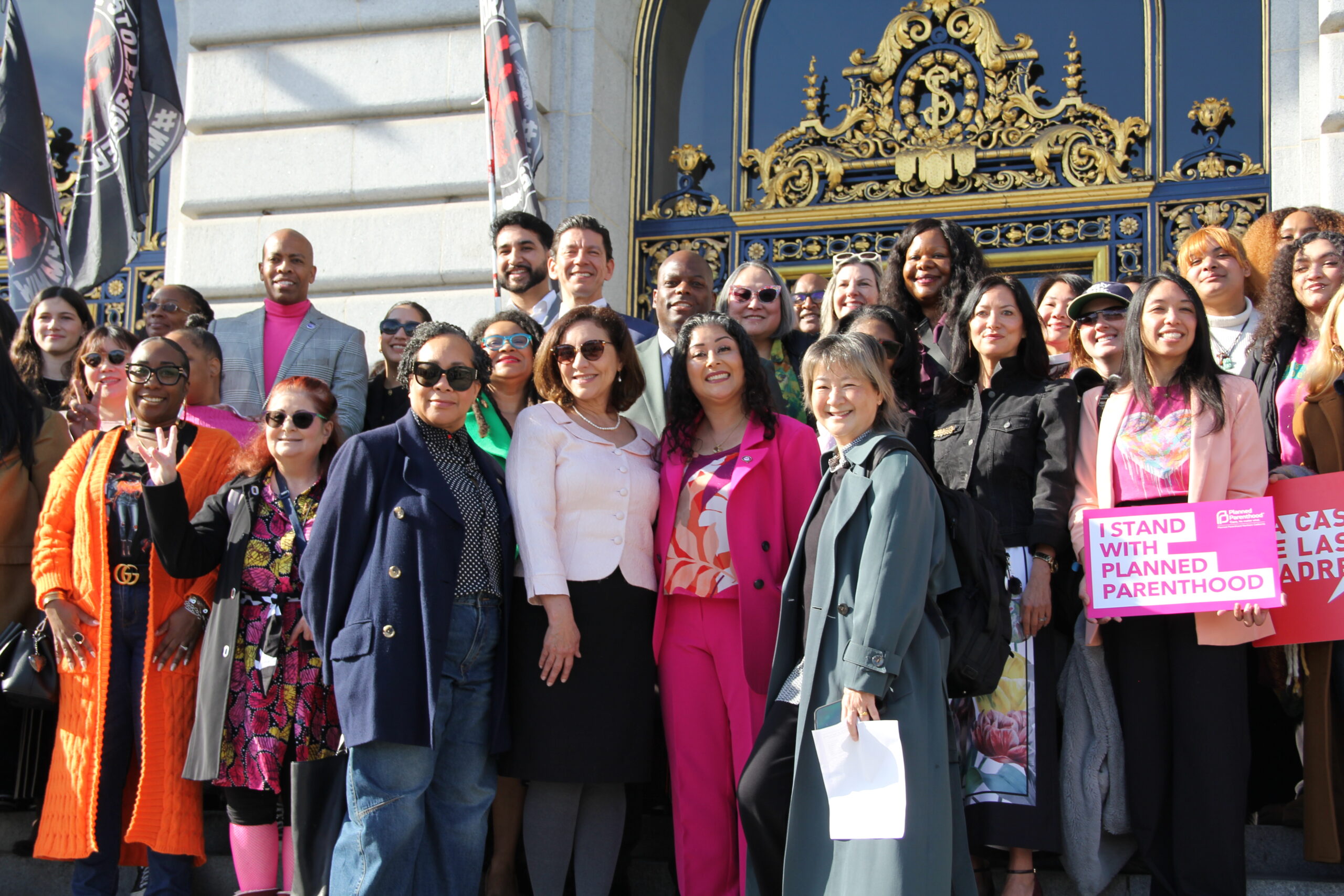
On a cold, clear Thursday morning, community members gathered on the steps of San Francisco City Hall to mark the 53rd anniversary of Roe v. Wade — and to recommit to protecting reproductive freedom at a moment when those rights face unprecedented attack.
Organized by the San Francisco Department on the Status of Women, the January 22 rally brought together city leaders, healthcare providers, activists, youth advocates and community members to confront the ongoing consequences of the U.S. Supreme Court’s 2022 decision in Dobbs v. Jackson Women’s Health Organization, which overturned Roe and eliminated the federal constitutional right to abortion won by the same court in 1973.
“Despite these attempts to dismantle women’s reproductive rights, we are gathered today to reaffirm San Francisco’s commitment,” said Department on the Status of Women Executive Director Dr. Diana Aroche — not only to reproductive justice, but to “defend and ensure that our bodily autonomy, our right to contraception, our right to abortion care, [and] our fundamental right to full-scope reproductive health services are not only guaranteed, but actively protected.”
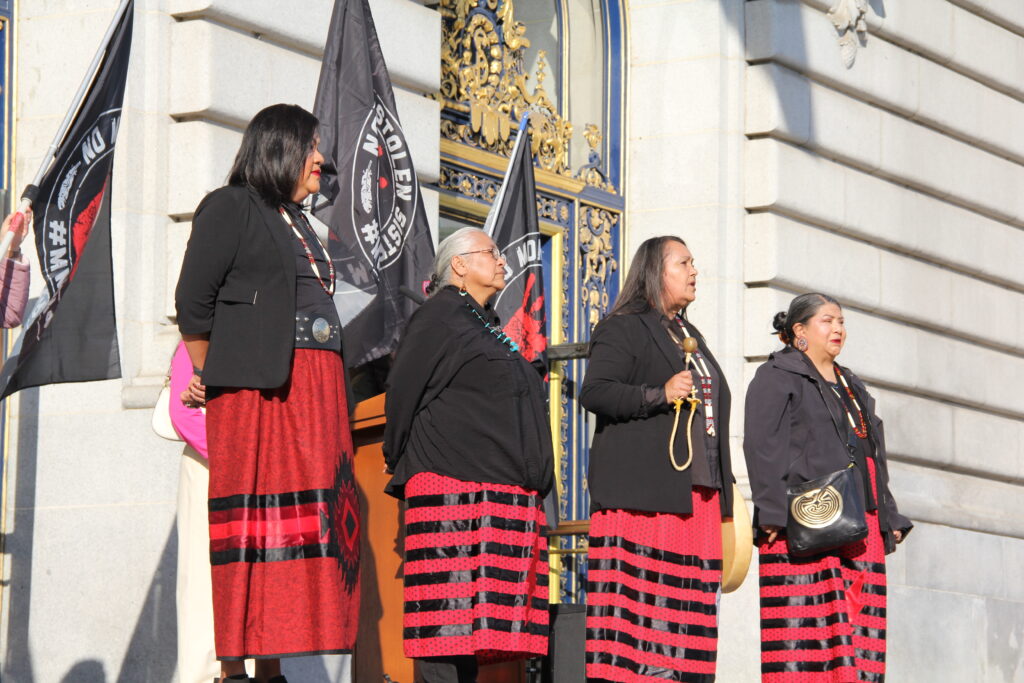
Opening the event, the Red Lightning Woman Power Singers offered Indigenous songs of healing, resilience and collective strength — grounding the morning in ceremony and resistance. Aroche followed with a land acknowledgment honoring the Ohlone, the original stewards of San Francisco and the greater Bay Area.
“Reproductive justice is fundamental to gender equity, health and human dignity,” Aroche said. “San Francisco remains steadfast in protecting and expanding access to reproductive care for all who need it.”
A Foundation of Resistance
San Francisco Mayor Daniel Lurie echoed that affirmation, standing beside his wife, Becca Prowda, director of protocol for California Gov. Gavin Newsom.
“Every person has the right to make decisions about their own body and their own future,” Lurie said.
Recognizing that “women’s rights are under attack” nationwide, Lurie noted that since the fall of Roe, some states have moved “aggressively to restrict access to abortion and even criminalize health care.”
“These actions threaten not only individual freedom, but women’s health, equality and opportunity,” he said, reminding the crowd that San Franciscans overwhelmingly passed Proposition O to protect reproductive rights and women’s healthcare, and that the Board of Supervisors reaffirmed the city’s commitment to reproductive freedom.
“San Francisco stands firmly against that tide,” Lurie said. “We are and will remain a city that protects and expands reproductive freedom.”
“Ensuring access to these essential services is foundational to economic opportunity, community stability, and a safer, healthier San Francisco,” he added. “Those are San Francisco’s values today, and they will be every day going forward.”
Supervisor Myrna Melgar (D7) underscored that commitment, speaking about her three daughters.
“We reaffirmed our city and our values. We will not back down from upholding those values and protecting reproductive freedom,” Melgar said. “I want my daughters and all our young people to know that their health and their safety matter — regardless of what government officials are doing at the national level. San Francisco will always protect our right to access healthcare and bodily autonomy.
“Today, we stand together not to mourn, but to mobilize,” she said. “Local governments are on the front lines. San Francisco will do what we have always done — stand at the forefront of freedom.”
Leading a call-and-response chant that echoed across Civic Center Plaza, Aroche called out “reproductive,” prompting the crowd to answer, “freedom.”
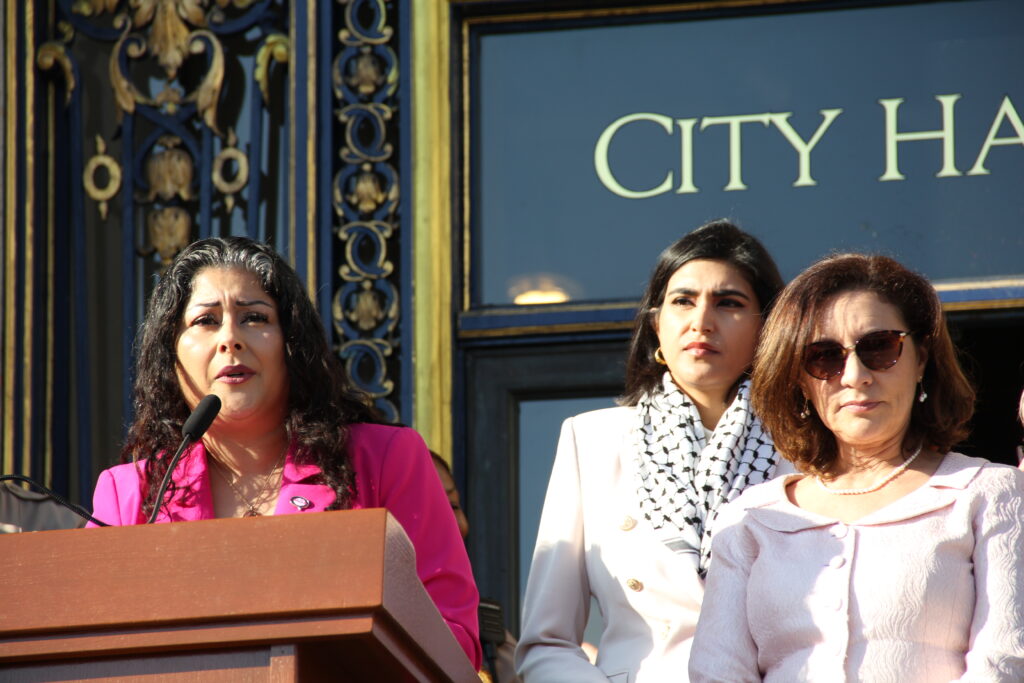
“Today, we honor the legacy of our grandmothers, our aunts, our sisters, and those who fought for generations to secure the rights we have today,” Aroche said. “Yes, there have been attacks. Yes, there have been losses. But we are still standing.”
A National Crisis, A Local Refuge
San Francisco City Attorney David Chiu framed the moment bluntly: the United States is now facing the most precarious era for reproductive rights in modern history.
Since Roe was overturned, 23 states have banned or severely restricted abortion, Chiu said. Women in those states are now nearly twice as likely to die during pregnancy or childbirth, and the US maternal mortality rate is three times higher than in other high-income countries.
“These are not abstract legal debates,” Chiu said. “These are life-and-death realities.”
As access collapses across large swaths of the country, California — and San Francisco in particular — has become a critical refuge, said Amy Moy, co-CEO of Essential Access Health. Clinics across Northern California are seeing sharp increases in patients traveling hundreds of miles to receive care.
“San Francisco is stepping up,” Chiu said, noting that he helped launch the Legal Alliance for Reproductive Rights with Yolanda Jackson, executive director and general counsel of the San Francisco Bar Association. He also serves on the California Reproductive Task Force, both groups were created in response to the Supreme Court’s ruling. “But the scale of national need continues to grow.”
Launched in 2022, LARR is a referral network of more than 70 law firms providing pro bono legal assistance to individuals, healthcare providers and organizations facing criminalization or civil litigation for seeking or facilitating reproductive care.
Spearheaded by California Attorney General Rob Bonta and led by the state Department of Justice, the CRTF is a coalition of district attorneys, county counsel and city attorneys from across the state that uses its legal and law enforcement authority to “ensure that every corner of California is safe for those seeking or providing reproductive care,” according to a news release from Bonta’s office.
Chiu noted that three of the 14 lawsuits his office has filed against the Trump administration involve anti-choice policies affecting access to healthcare.
“San Francisco will always be a haven for abortion care and reproductive freedoms,” he said.
Yet even within that sanctuary, patients and providers continue to face harassment and intimidation.
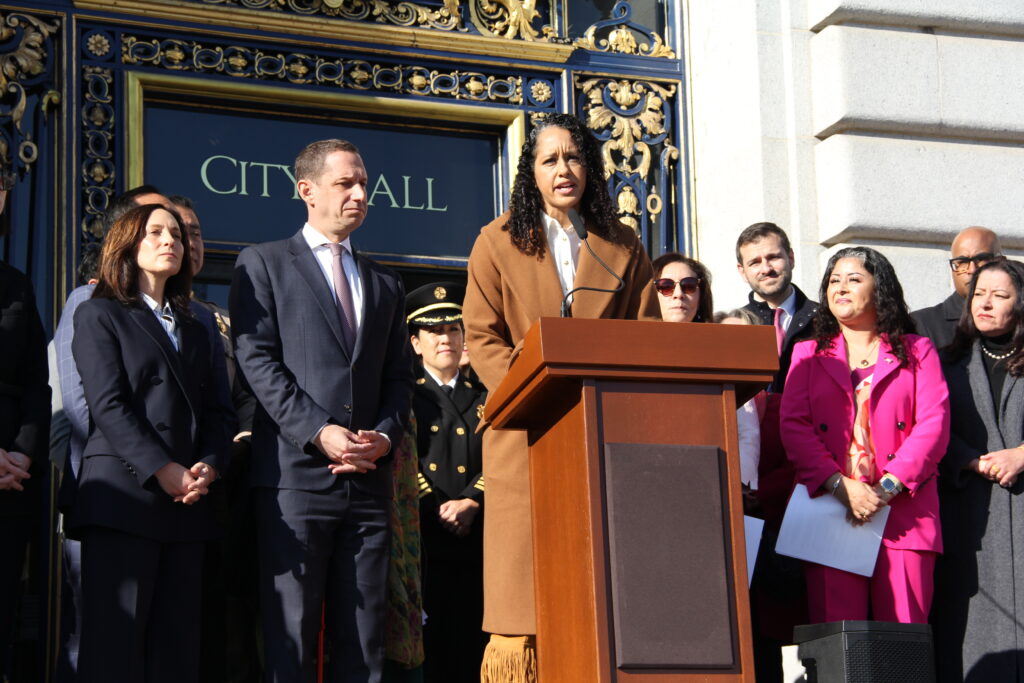
“We know there are laws that protect our rights to access this care, yet far too often we see those rights violated,” said San Francisco District Attorney Brooke Jenkins. “People are harassed, stalked and threatened simply for seeking or providing care.”
“You don’t have to be scared,” said Jenkins, who is also a member of CRTF, said. “You can get the care that you need.”
Speaking personally, Jenkins described her own experience terminating a pregnancy that threatened her life.
“Even lifesaving care is now illegal in some states,” she said. “That is something this country must address. We cannot stand for it.”
Demand Surges as Access Disappears
Dr. Nicole Barnett, president and CEO of Planned Parenthood Northern California, said the post-Roe landscape has radically transformed healthcare delivery.
“Patients are traveling from across the country to California because their home states have stripped them of basic reproductive healthcare,” Barnett said. Clinics are seeing patients arrive later in pregnancy after navigating legal barriers, travel costs and long wait times.
“This is not theoretical,” she said. “These policies are forcing real people into impossible situations.”
Barnett reminded the crowd that Roe v. Wade affirmed a simple but revolutionary idea: that people have the right to control their own bodies and futures.
“It gave people the power to choose their paths and made clear that healthcare is not a privilege — it is a human right,” she said.
Cecilia Chung, a transgender woman who is a commissioner on the Commission on the Status of Women, emphasized that the ruling’s reversal carries profound consequences for transgender and nonbinary communities.
“Ultimately, Roe asks a fundamental question: who gets to decide what happens to our bodies?” Chung said. “For women, for transgender and nonbinary people, and for communities like San Francisco, the answer has lasting consequences for freedom, safety and dignity.”
Barnett added that despite political attacks and funding cuts, Planned Parenthood remains resolute.
“We are meeting this moment with resilience, courage and resolve,” she said. “This fight is not only about today — it’s about our future.”
When Bans Become Emergencies
Seven states now enforce so-called heartbeat laws, effectively banning abortion as early as five or six weeks — often before people even realize they are pregnant, said Nadia Rahman, principal of Rahman Consulting.
Interviewing a physician relative who specializes in obstetric anesthesia, Rahman described the devastating medical consequences of the new restrictions, including rising rates of infection, sepsis and maternal death when miscarriages and pregnancy complications cannot be properly treated.
“Abortion is healthcare.” said Moy calling out the dangerous policies denying access as “inhumane and dangerous.”
“Extreme, bans and restrictions” are “state sanctioned violence against people who can get pregnant and strip them of bodily autonomy and puts their lives at risk.”
Clinics Close, Barriers Rise
Moy warned that nationwide clinic closures, funding cuts and legal threats are placing enormous strain on remaining providers.
“Millions now live in states where abortion is banned or severely restricted,” she said. “Patients travel hundreds of miles. Clinics have closed. Providers face criminal penalties simply for doing their jobs.”
Longstanding federal programs that provide contraception and preventive care have also been repeatedly targeted, compounding barriers for low-income patients and communities of color.
A Legacy of Advocacy
The new wave of abortion bans echoes the pre-Roe era — a time when San Francisco stood at the center of the fight to legalize abortion.
In the early 20th century, Inez Brown Burns quietly — and sometimes not so quietly — operated one of the nation’s largest underground abortion networks, providing tens of thousands of procedures when safe medical care was otherwise inaccessible.
Decades later, San Francisco activist Patricia “Pat” Maginnis helped launch the modern abortion rights movement, co-founding the organization that would become Reproductive Freedom for All (formerly NARAL Pro-Choice America), pushing abortion rights into national political debate.
This dual legacy — underground care and radical public advocacy — helped shape San Francisco into the reproductive justice stronghold it remains today.
Why This Moment Matters
As San Francisco Youth Commission Vice Chair Téa Lonné Amir reminded the crowd, the rollback of reproductive rights is shaping how an entire generation makes decisions — including where they feel safe attending college, building careers, or starting families.
The rally closed with a renewed sense of urgency and solidarity — a collective reminder that reproductive rights are human rights.
And in San Francisco, that freedom remains something worth fighting for — together.