By Heather Cassell
Advocates are calling on the public to weigh in this week as the fight to expand landmark protections for the historic Compton’s Cafeteria riots site enters a critical new phase, with written comments due Monday and a public hearing scheduled Wednesday at City Hall.
The upcoming hearing follows a unanimous 7–0 vote by the San Francisco Historic Preservation Commission on January 21 to initiate expanding protections for the building and surrounding area at Turk and Taylor streets, widely recognized as the site of the 1966 Compton’s Cafeteria uprising.
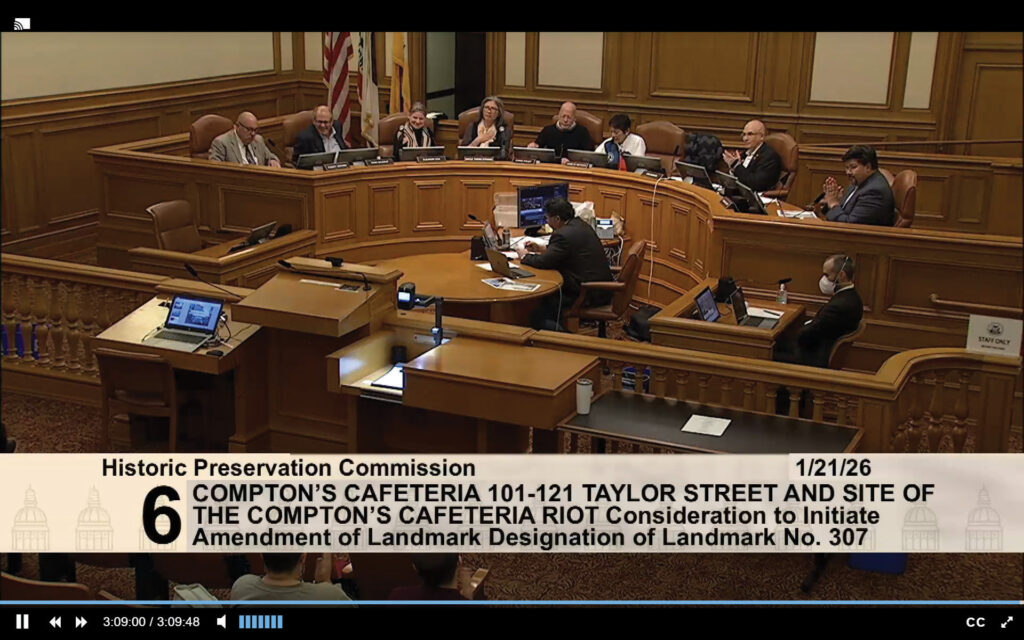
The vote came after more than an hour of testimony from historians, community leaders, activists and residents and concluded with an emotional ovation as commissioners approved the measure. Transgender advocates and supporters erupted in cheers shortly after 3:40 p.m. in Room 400 at San Francisco City Hall.
Now community members and advocates are urging the public to submit comments and attend the hearing in support of expanding the city’s existing landmark designation in the Tenderloin.
Written comments are due by 8 a.m. Monday, March 30, though submissions will be accepted until 9:30 a.m. Wednesday, April 1.
The commission is scheduled to hold a hearing at 12:30 p.m. Wednesday, April 1, in Room 400 at San Francisco City Hall.
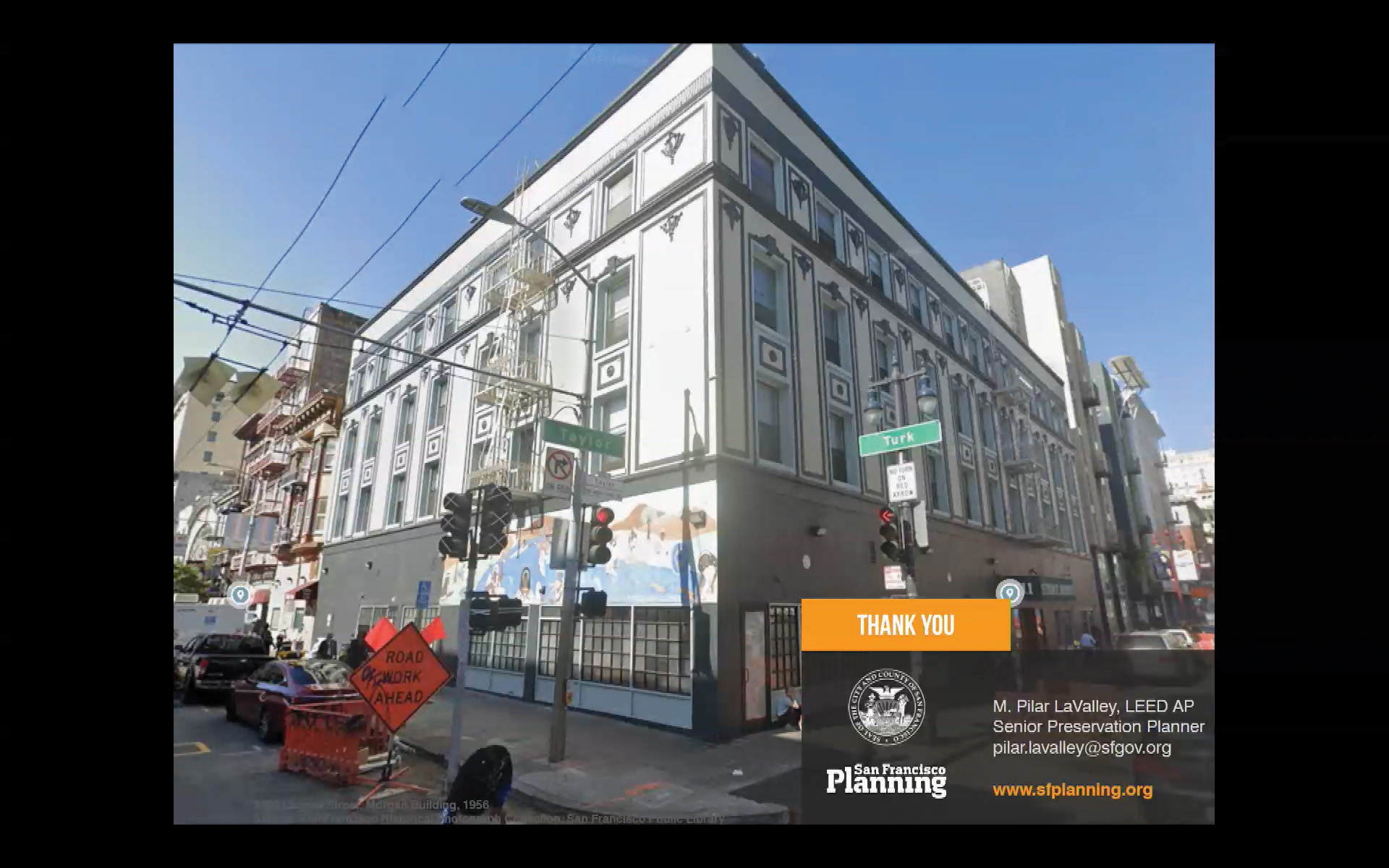
The proposed expansion would amend the existing landmark designation to include the full four-story building at 101–121 Taylor St. and the surrounding public right-of-way as a historic district.
The expanded designation builds on the site’s 2022 landmark status, which protected only a portion of the exterior wall and sidewalk. The revised boundaries encompass the entire building parcel and adjacent streetscape, reflecting what commissioners and historians described as the site’s broader cultural and historical significance.
“Expanding the landmark is a meaningful way for the city to acknowledge that history, accurately and publicly,” said Andrea Horne, a historian and Black transgender woman who addressed commissioners.
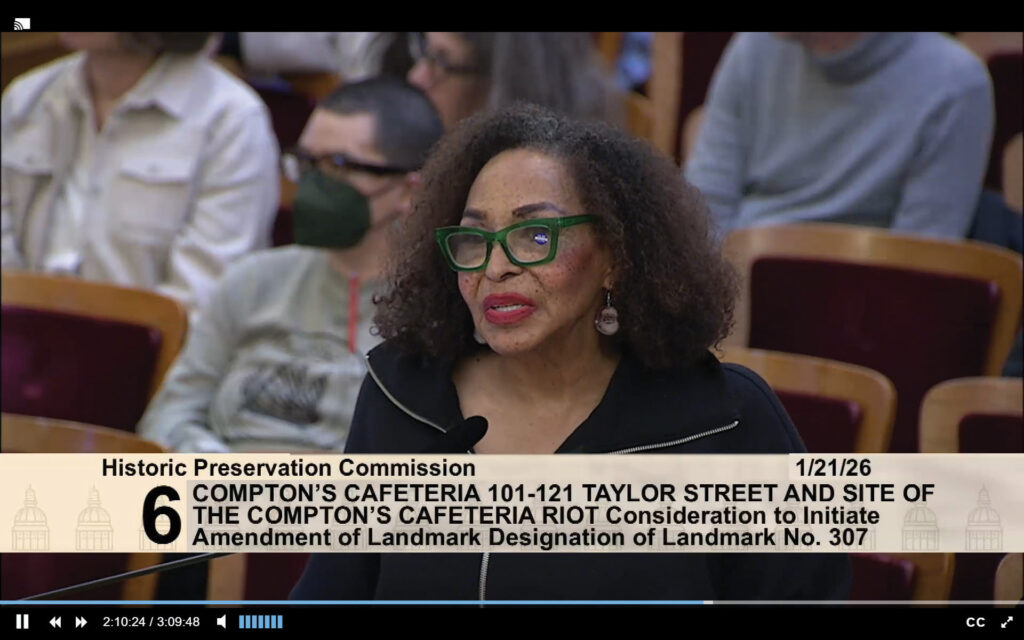
During her brief presentation, Horne said there were three reasons why the community was asking to expand landmark designation for the Compton’s Cafeteria Riots site this year: to update historical record to accurately reflect the function of the space and “how events unfolded,” to align designation with the National Register listing, and this year marks the 60th anniversary of the Compton’s Cafeteria Riots.
In an email submitted ahead of the hearing, attorneys for WBP Leasing Inc., the building’s owner, said the company supports the proposed expansion of the landmark designation, calling it “appropriate and consistent with the site’s historic significance.”
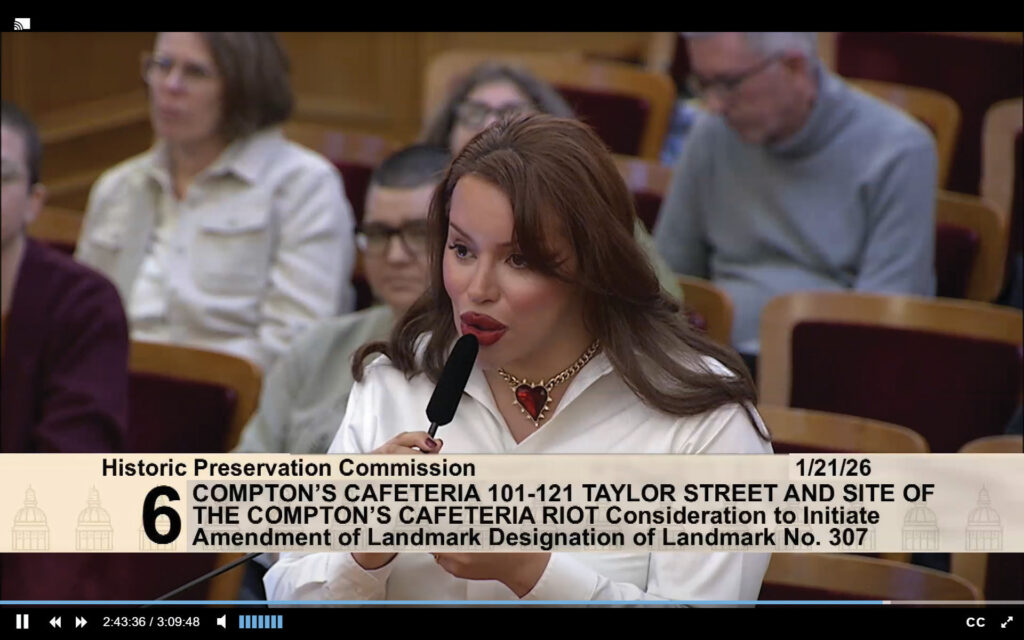
Santana Tapia, lead organizer of the Compton’s x Coalition, a grassroots group working to reclaim the site, which sponsored the landmark application, told the commissioners, “The history of Compton’s Cafeteria is not just at the intersection of Turk and Taylor. It lives in the building. It lives in the doors and each floor of this historic site.”
“History is messy,” Commissioner Hans Baldauf said recognizing historic preservation should expand beyond the building but to the surrounding structures that make up the district around it. “Compton’s Cafeteria is a fabulous example of that. This is a case where the power exists in the whole place — inside and outside.”
A Legacy of Resistance
The site was the location of the August 1966 Compton’s Cafeteria riot, one of the nation’s earliest recorded uprisings against police harassment of transgender people. Transgender women, drag queens and queer youth fought back after years of abuse, three years before the better-known 1969 Stonewall uprising in New York.
According to historians, a customer threw a cup of hot coffee at a police officer attempting to arrest her at the 24-hour diner, igniting a confrontation that spilled into the street.
The event has gained renewed attention through scholarship, documentary film and an immersive theater production, Compton’s Cafeteria Riot, which opened in April 2025 and has consistently sold out.
Mark Nasser, who co-wrote and produced the play with transgender elders Donna Personna and Colette LeGrande, urged commissioners to support the expansion.
“They need a win here,” Nasser said, describing walking through the Tenderloin with the women and witnessing harassment. “My heart is just broken by that experience. San Francisco is the capital of the LGBTQ world — I hope you can help us grasp that history.”
A Modern Crisis
The vote comes amid a national surge in violence and legislative attacks targeting transgender people.
In 2025 alone, at least 27 transgender and gender-nonconforming people were killed in the United States, according to the Human Rights Campaign Foundation. Since 2013, nearly 400 trans and gender-nonconforming people have been victims of fatal violence, with more than 70% of victims being people of color and nearly 60% Black transgender women.
At the same time, hundreds of anti-transgender bills were introduced nationwide in 2025, with more than 100 additional measures filed in early 2026, according to tracking by translegislation.com and the American Civil Liberties Union. The proposals target gender-affirming health care, public accommodations, education and participation in sports.
While the city moves to preserve the past, local advocates are raising alarms about the present. The Bay Area Reporterreported a day after the landmark vote, a letter sent on January 22, 2026, to Mayor Daniel Lurie by a former employee claims the city’s Office of Transgender Initiatives has seen a “steady erosion of capacity” since its 2024 restructure.
The report details several alleged setbacks, including the loss of the office’s physical space at the SF LGBT Center, the elimination of key staff positions like the office manager, and a “pending leadership demotion” of the OTI director that would reduce both authority and compensation. Honey Mahogany, the office’s executive director, confirmed to the B.A.R. that the office would be moving out of the LGBT Center to 25 Van Ness Avenue. following a lease cancellation.
Additionally, the Transgender Cultural District lost a significant amount of city funding in 2025, due to budget shortfalls and scandals that shook the Dream Keeper Initiative, one of the city-backed granting entities, to the Department on the Status of Women and the Human Rights Commission, which managed the DKI. At the beginning of last year, then-new Mayor Daniel Lurie initiated a hiring and funding freeze that ended up canceling millions of dollars in city grants to programs that had already been awarded the funds, including for the TCD. Some organizations, like the TCD, eventually received some grant funding from the city, co-director Breonna McCree told Her Past. Her Power, Go Roam Tours forthcoming newsletter, but not all that was promised. The shortfall forced the organization to cut some of its programs, including a successful entrepreneurial accelerator program and harmed many other women’s, Black, brown, Indigenous, and people of color organizations, I was reporting on at the time.
Against that backdrop, preservation advocates framed the vote as both historical recognition and present-day affirmation.
“At a moment when trans lives are under attack across the country, this vote matters,” said openly lesbian architectural historian Shayne Watson, founder of Watson Heritage Consulting. Watson was one of nearly 20 community members and historians who testified in support of expanding the historic preservation of the former site of Compton’s Cafeteria during public comments.
“It tells our community: you belong, your history matters, and your survival matters,” she told the commissioners.
Uncovering Lost History
The updated designation also expands the site’s “period of significance” to include the mid-1960s through the mid-1970s, when the upper floors — then operating as the Hyland Hotel — served as a rare residential refuge for transgender women.
Transgender historian Susan Stryker, who began researching the riot in 1991 — work that later became the Emmy-winning documentary Screaming Queens: The Riot at Compton’s Cafeteria, testified about what she called the “violence of erasure” that has obscured the event from public memory.
Responding to Commissioner Robert Vergara’s question about the exact date of the riot, Stryker told commissioners that mainstream newspapers and even the gay press of the 1960s often suppressed accounts of “street queens” confronting police, viewing their resistance as politically inconvenient or socially disreputable.
Pointing to what she described as possible collaboration between reporters and police, Stryker noted that one of the journalists on the scene during the early morning hours of the riot was Dick Carlson, a television reporter who later became a conservative political commentator and the father of former Fox News host Tucker Carlson.
“The fact that we still cannot pin down the exact date tells us something,” she said. “There is a reason that knowledge is not preserved in the mainstream.”
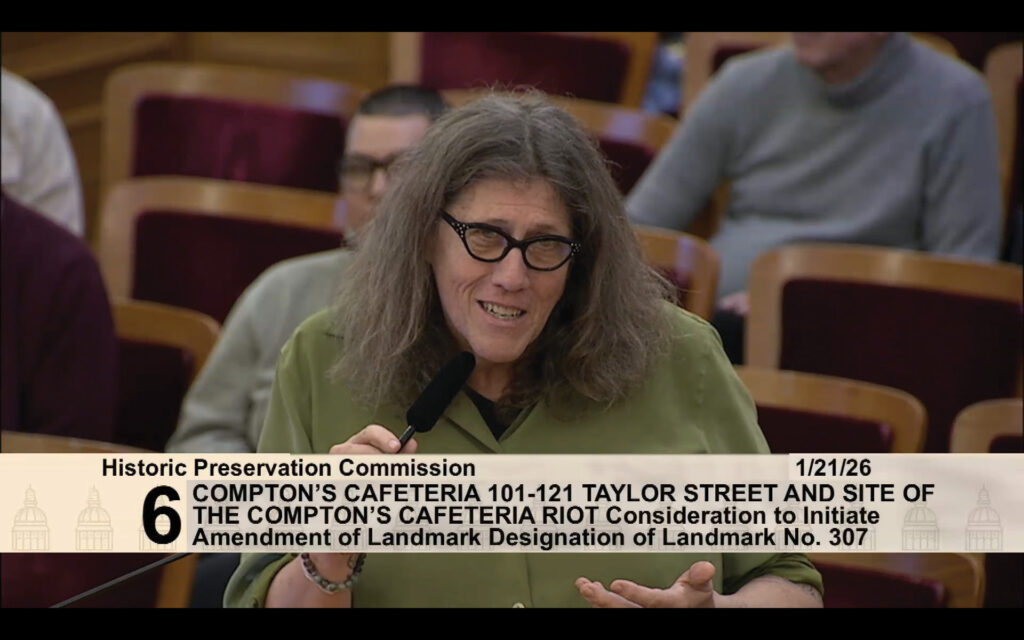
Stryker said three decades of research suggest the riot likely occurred in late August 1966, possibly coinciding with the nation’s first national homophile conference, which opened in San Francisco on August 22 that year, but definitive documentation remains elusive. LGBTQ people commonly identified as “homophiles” at the time.
“I think the gay press did not want to talk about street queens fighting cops in the Tenderloin,” Stryker said, noting that mainstream and LGBTQ media in the 1960s often suppressed such accounts.
Few photographs of Compton’s Cafeteria exist, a gap in the historical record that preservation advocates say underscores the urgency of protecting the physical site.
Stryker said she remains hopeful that new documentation may still emerge.
“Maybe we’ll turn over a stone,” she said. “And there it will be.”
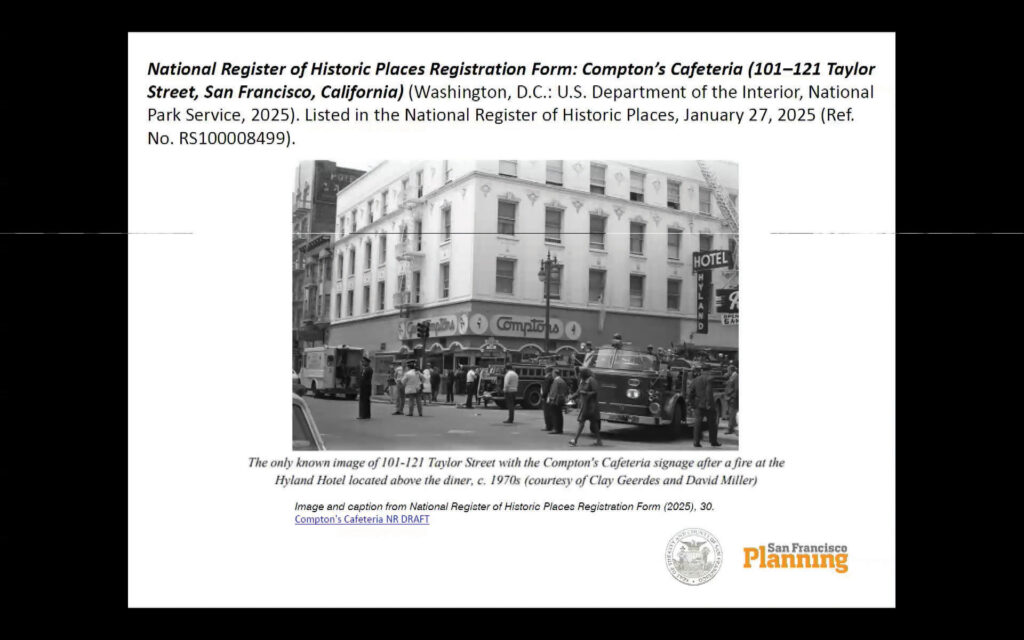
An example is the discovery of photographer Clay Geerdes’ 1970s photos of San Francisco firefighters outside Compton’s Cafeteria that resurfaced in 2021. The long-lost images were being posted on Facebook, offering one of the only known exterior views of the diner and its distinctive glass-wrapped façade.
The San Francisco Chronicle reported the photographs captured firefighters responding to a blaze at the adjacent Hyland Hotel, restoring what historians described as a “lost bit of critical history.”
Stryker noted to the newspaper that the 1970 photo of firetrucks outside Compton’s Cafeteria and the Hyland Hotel appear to document “a suspicious fire” at a time when the owners were actively “attempting to change its clientele” by pushing out transgender residents.
“This gives us the real setting,” Randy Shaw, founder of the Tenderloin Museum, told the Chronicle.
Next Steps
The building received federal landmark status in January 2025, becoming the first site in the nation formally recognized for its connection to transgender history. It is also listed on the California Register of Historical Resources. However, those designations do not prevent demolition or major alterations.
Outside Room 400, Tapia called the decision a vital step toward protecting a site central to transgender resistance and survival.
“This space protected our people for so many nights,” she said. “Preserving it means future generations can stand where we stood and know that our resistance mattered.”
The recommendation now moves to the San Francisco Board of Supervisors for final approval. If adopted, the expanded designation would require heightened review of any changes to the building’s interior and exterior, providing long-term protections under city planning law.
Comments can be submitted to the San Francisco Historic Preservation Commission at commissions.secretary@sfgov.org.
Disclosure: This article was written with the assistance of AI, but human researched, fact-checked, and edited.